Can AI Replace Web Designers? Here’s What the Data Actually Says in 2026


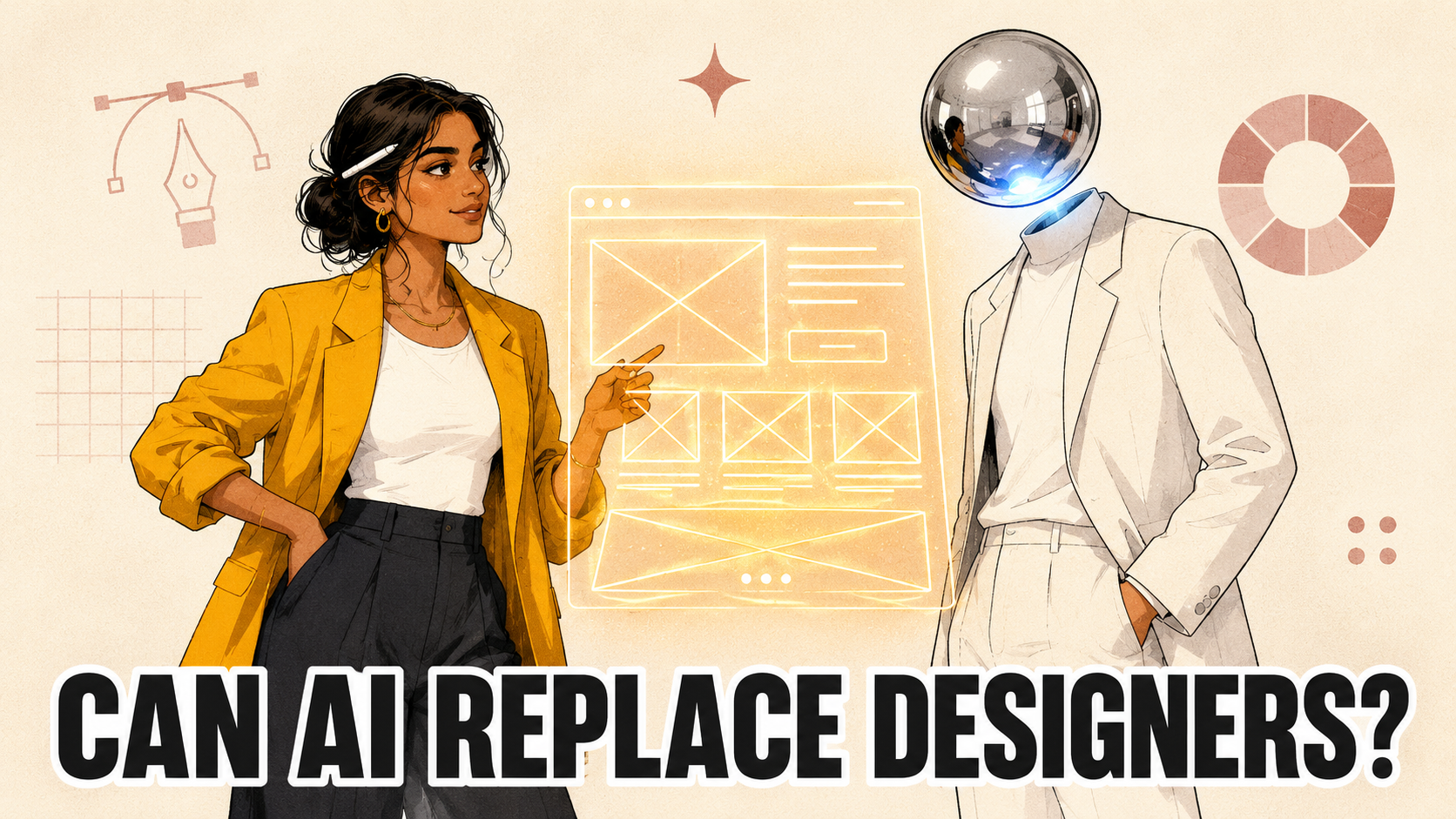
Can AI replace web designers? It is one of the most searched questions in the design industry right now and it deserves a better answer than the ones you keep finding.
Most articles give you one of two takes. Either “AI is coming for your job, start panicking” or “don’t worry, creativity can’t be automated.” Both feel like they’re missing something. The first is designed to frighten you into clicking. The second is designed to comfort you without telling you anything useful.
The real answer sits in the data and the data tells a genuinely interesting story. Not a scary one. Not a dismissive one. An honest one that every freelance web designer, graphic designer, and UX designer needs to hear right now.
As 2026 unfolds, 93% of web designers have already integrated AI into their daily workflows, treating it more like a high-powered assistant than a replacement. According to Figma’s 2025 AI report, 78% of designers say AI boosts their work efficiency, and 85% believe learning to work with AI will be essential to their future success.
Read that again. Not 93% of designers are being replaced by AI. 93% of them are using it.
The global AI in design market is projected to reach $1.3 trillion by 2032 expanding total industry opportunities, not shrinking them. That is not a market contracting around designers. That is a market growing around people who know how to work with design and AI together.
A 2026 survey by Namecheap found that 75% of web design professionals report AI-driven competition has already affected their business and 76% rank rising AI use as their number-one future concern, outranking shrinking client budgets and the cost of tools.
So yes, the concern is real. The disruption is real. But disruption and replacement are two very different things, and collapsing them into the same idea is where most of this conversation goes wrong.
McKinsey data shows AI can automate 80% of repetitive design tasks right now resizing assets, naming files, writing basic structural code, generating layout variations.
That’s the honest part of this conversation that designers need to sit with. Not to panic but to be clear-eyed. If your day is mostly filled with:
Then yes, AI is already doing most of that work or it will be very soon. Not because AI is smarter than you. Because those tasks were never the actual value you were providing. They were the scaffolding around your value, and the scaffolding is being automated.
The designers who win in 2026 are completely fine letting the machine do the boring part. AI will not replace designers. But it will definitely replace template jockeys’ designers who only move pixels and never talk to users, people whose only differentiator is “I can make it look clean.”
The question is not whether AI is replacing those tasks. It is. The question is what you build your value around instead.
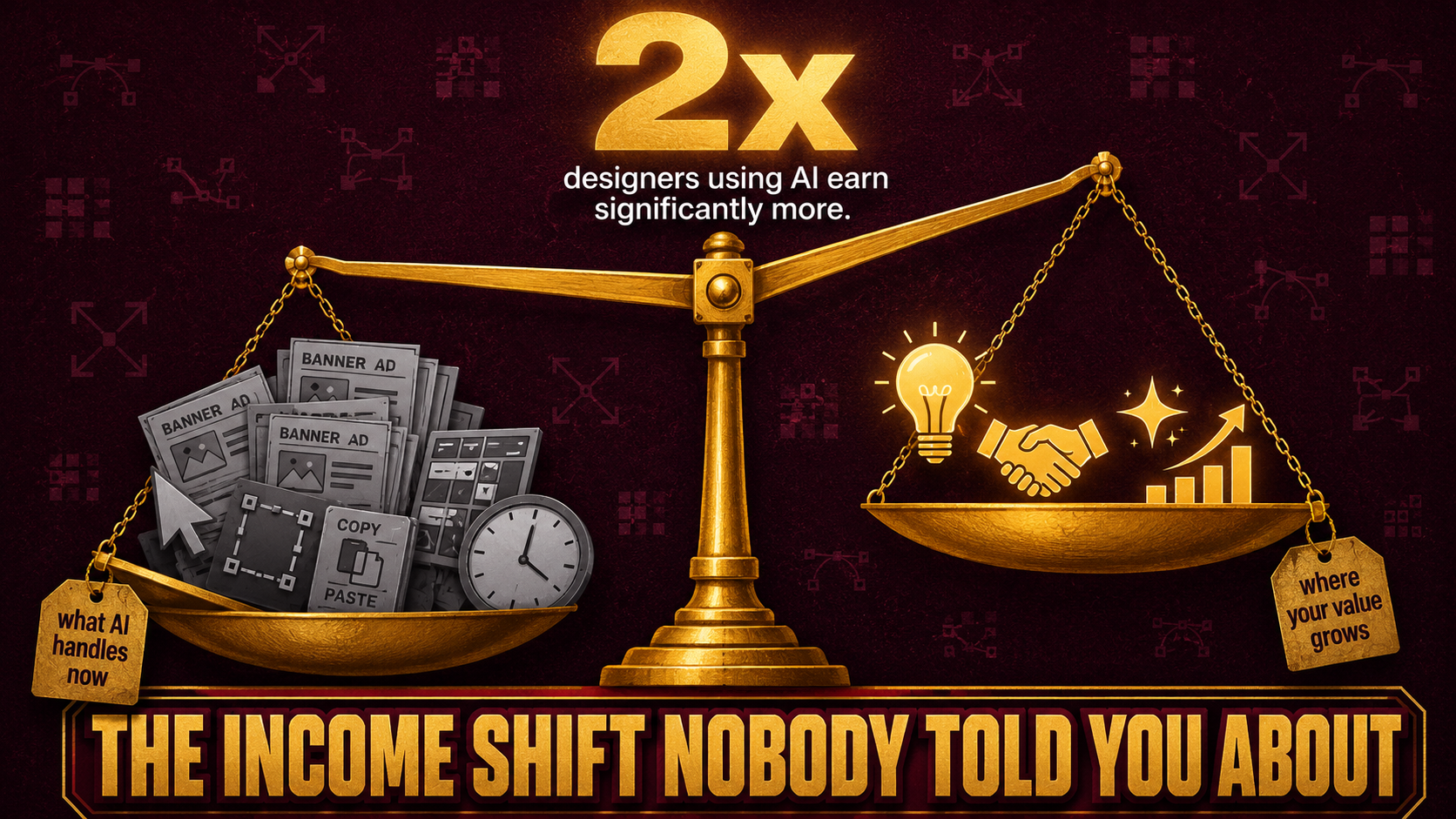
Here’s what changes everything: the designers who have embraced AI are not earning less. They are earning significantly more.
The average annual salary of an AI Designer in the United States as of 2026 is $83,148 – nearly double the average freelance web designer rate of $43,750. The difference between those two numbers is not talent. It’s positioning. It’s the difference between a designer who uses AI fluently and one who doesn’t.
AI tools free designers from repetitive tasks, allowing them to focus on higher-level strategic and creative work. This increased efficiency leads to the ability to take on more projects and for freelancers, time saved directly translates to higher effective hourly rates.
Think about what that means practically. If AI compresses what used to be a two-week project into five days without reducing the quality of the output you have just created nine days of capacity. That is nine days you can fill with another client, with a higher-value project, with business development, with learning. The designer who sees that as a threat is giving away the biggest competitive advantage in the industry right now.
Web design incomes show a broad distribution in 2026, with over a third – 36.6% – of professionals now earning over $100,000 annually, and 6.4% earning over $200,000. Experienced designers are commanding significant compensation but entry-level income remains modest.
The gap between the top of the market and the bottom is widening. That is not a coincidence. It reflects a market sorting itself into two tiers: designers who provide genuine strategic value, and those who compete on execution alone. AI is accelerating that split.
Across AI-related job postings in web development in 2026, communication ranks as the fourth most in-demand skill. Design thinking understanding what a business actually needs and translating that into an effective digital experience has overtaken raw technical ability as the most valued capability. These are not skills that improve by writing more code. They improve through client work, project management experience, and genuine creative practice.
Let that sink in. The skills that AI cannot replicate are moving up the value chain, not down it. The ability to walk into a client conversation and understand what their business actually needs and translate that into a digital experience that serves it is worth more in 2026 than the ability to hand-code a responsive navigation bar.
Here is what is genuinely becoming more valuable for designers in 2026:
Strategic thinking over execution. Clients are hiring designers less to produce pixels and more to solve problems. What should this website make people feel? What action do we want them to take and why aren’t they taking it? Where does the brand need to be positioned differently? These are questions that require human judgment, business understanding, and design experience. AI can answer none of them without significant human direction.
Taste and creative direction. Only 31% of designers currently use AI for core design work — compared to 59% of developers who use AI for core development tasks. This isn’t because designers are slow to adopt. It’s because design requires judgment about what feels right — taste, restraint, originality — that AI currently approximates but does not replicate. The ability to look at AI output and know precisely what is wrong with it, and how to fix it, is a skill with genuine market value.
Specialization over generalism. The most defensible position in 2026 is not a broad generalist skillset. A generalist who builds any website for anyone is competing against AI builders in a race to the bottom. A specialist who handles a specific type of client, industry, or problem is competing against almost no one. A designer who specializes in high-converting e-commerce for D2C brands, or in SaaS onboarding UX, or in conversion-focused landing pages for service businesses, is not competing with AI. They are providing something AI cannot assemble from a prompt.
Client relationship and trust. No AI tool builds the kind of trust that makes a client refer three more clients. No AI follows up after launch to review performance, spots a conversion issue before the client notices it, and adjusts the design accordingly. The relationship layer of design work – the part that turns a single project into a long-term retainer is entirely human, and it always will be.
The right frame for this is not “what can AI do instead of me.” It is “what can I do now that I couldn’t before.”
Organizations report prototyping speed improvements of up to 90% when implementing AI design workflows effectively. Ninety percent. A prototype that used to take a week now takes a morning. That is not a threat to a designer’s business – it is an enormous commercial advantage if you know how to use it.
Here is what AI has genuinely unlocked for working designers and freelancers:
Delivering more, faster. A freelance designer who uses AI tools for wireframing, copy generation, and asset creation can deliver the same quality of work in significantly less time taking on more projects, moving faster for clients, and earning more per hour without increasing their rate.
Pitching with prototypes, not proposals. Where a designer used to send a written proposal and wait for approval, they can now send a visual concept built in hours. Research consistently shows that clients close significantly faster when they can see a real direction early. AI makes this possible without weeks of unpaid concept work.
Expanding what you can offer. A graphic designer who adds AI-assisted web design capabilities using tools like Framer, Webflow, or AI-powered prototyping tools can offer a fuller service without hiring developers. A web designer who uses AI copywriting tools can offer copy-inclusive packages. AI is breaking down the skill silos that used to limit what a solo designer could deliver.
Competing with larger agencies. A solo freelancer using AI tools in 2026 can produce work at a quality and speed that used to require a team. That is a genuine leveling of a playing field that was historically tilted toward larger operations. For independent designers, this is one of the most significant market changes in a generation.
Testing more ideas. AI allows designers to explore ten directions quickly instead of committing to one direction and developing it fully. This changes the creative process in a fundamental way making exploration faster, reducing the cost of a wrong creative direction, and ultimately producing better final outcomes because more options were considered.
Here is what the data actually points to as the genuine risk for designers in 2026.
The threat is not AI replacing you. The threat is other designers who use AI replacing you. The mindset must shift away from input-based thinking where value is tied to hours spent toward value-based thinking, where value lies in the decisions made and the results delivered, such as conversions and trust, rather than the manual act of producing the work.
A designer who uses AI to work at three times the speed can take on three times the clients. A designer who uses AI for assets and copy can offer more comprehensive packages. A designer who uses AI-powered analytics understands what’s working for clients and can prove it. These designers are not being replaced by AI. They are using AI to outcompete designers who aren’t.
Demand for AI-related freelance skills on Upwork grew 109% year-over-year in 2026. The shift is that clients are now actively searching for freelancers who use AI because they know it means faster turnaround and better outcomes. The sell is not “I use AI.” The sell is outcomes and AI helps deliver them faster.
The data points in one clear direction: the designers building durable, growing careers in 2026 are those who have stopped asking “will AI replace me” and started asking “how do I use AI to become more valuable than I was before.”
That reframe is everything. It moves you from a defensive posture protecting what you do from automation to an offensive one, where automation is an asset you deploy on behalf of your clients.
Nearly 60% of designers say AI is now moderately or extensively integrated into their workflows up from 44.3% the previous year. Only 6% are not using it at all. The experiment phase is over.
The designers who will struggle in the next few years are not the ones who get replaced by AI. They are the ones who continue to compete on execution in a market that has already moved past valuing execution as the primary differentiator.
The ones who will thrive are those who use AI to do more, faster while building their practices around the things AI genuinely cannot do: strategic thinking, brand understanding, client trust, creative judgment, and accountability for results.
Custom-designed websites see a 33% higher conversion rate compared to purely AI-generated templates. That gap between what AI produces automatically and what a skilled designer builds deliberately is exactly where your value lives. It is not shrinking. If anything, as AI output becomes more ubiquitous and more generic, the premium on genuine design thinking is growing.
The question was never whether AI can replace web designers. The real question the one worth your energy is what kind of designer you want to be in the world that AI has created.
That answer is entirely yours to write.