How Businesses Use AI to Improve Website Conversion – Proven Strategies for 2026


How businesses use AI to improve website conversion is one of those topics that sounds like it belongs in a corporate whitepaper until you look at the actual numbers and realize the gap between businesses using AI for conversion and those that aren’t is no longer marginal. It is structural.
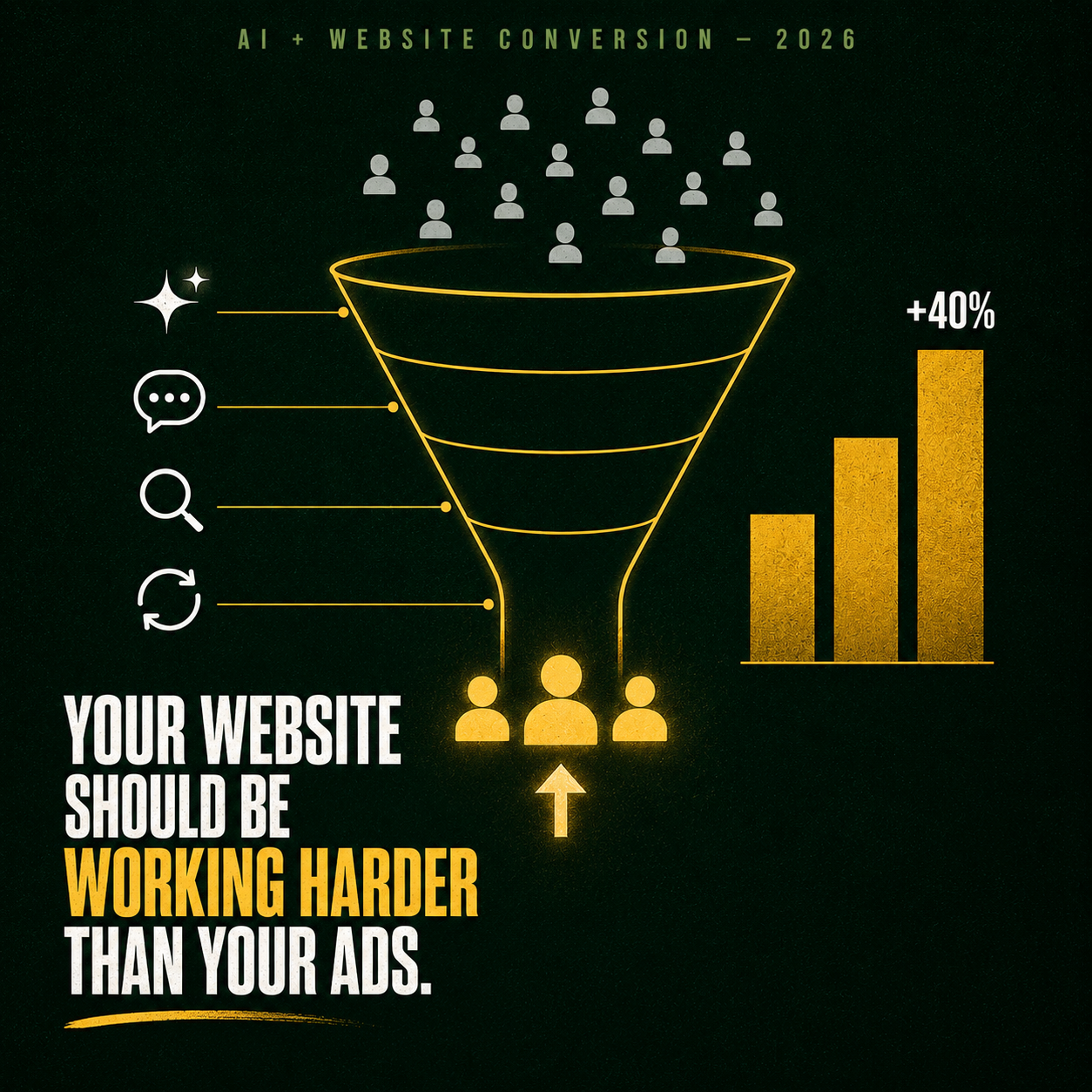
AI personalisation boosts revenue by 40%. AI chat increases conversion rates by 4x compared to non-assisted sessions. 65% of ecommerce brands report higher conversion rates after implementing personalisation strategies. These are not projections from optimistic vendor decks. These are documented outcomes from real businesses that made a deliberate decision to stop guessing and start letting AI do what it is genuinely good at.
And yet only 31% of companies have a structured approach to testing and optimisation. That means 69% of businesses are still relying on instinct, assumption, and whatever the web designer thought looked good at the time.
That gap is the opportunity. And in 2026, it’s larger than it has ever been.
Most businesses think about conversion as a design problem. The button is the wrong color. The page is too long. The form has too many fields. Fix those things and the numbers will go up.
That thinking is not wrong it’s just incomplete. Design friction is real and removing it helps. But the bigger conversion problem in 2026 isn’t friction. It’s relevance.
Your website shows the same thing to everyone who visits it. The founder who built the company sees the same homepage as the first-time visitor who has no idea what you do. The loyal returning customer who has bought three times sees the same product page as someone who bounced last week without purchasing. In an era where Netflix, Spotify, and Amazon adapt their entire experience to who’s using them your website is the one digital touchpoint that treats every human being as if they’re identical.
That is the conversion problem AI actually solves. Not button colors. Relevance at scale.
Personalisation is not new. What’s new is the ability to do it at scale, in real time, without a team of engineers maintaining rule sets.
Dynamic Yield, now owned by Mastercard and a 2026 Gartner Magic Quadrant leader, is the clearest example of what AI personalisation looks like at maturity. It delivers individualised experiences across web, mobile, email, and even in-store kiosks adapting product recommendations, hero content, pricing displays, and promotional messaging based on real-time signals from each visitor. The platform’s next-best-action machine learning models typically deliver 15-25% uplift in personalisation effectiveness for the brands that implement it properly.
For smaller businesses and mid-market ecommerce brands, Nosto and Bloomreach provide similar capability at a more accessible scale combining AI-powered product recommendations, merchandising rules, and behavioural pop-ups without the enterprise-grade implementation requirements. Bloomreach users report 251% ROI over three years from its AI personalisation engine.
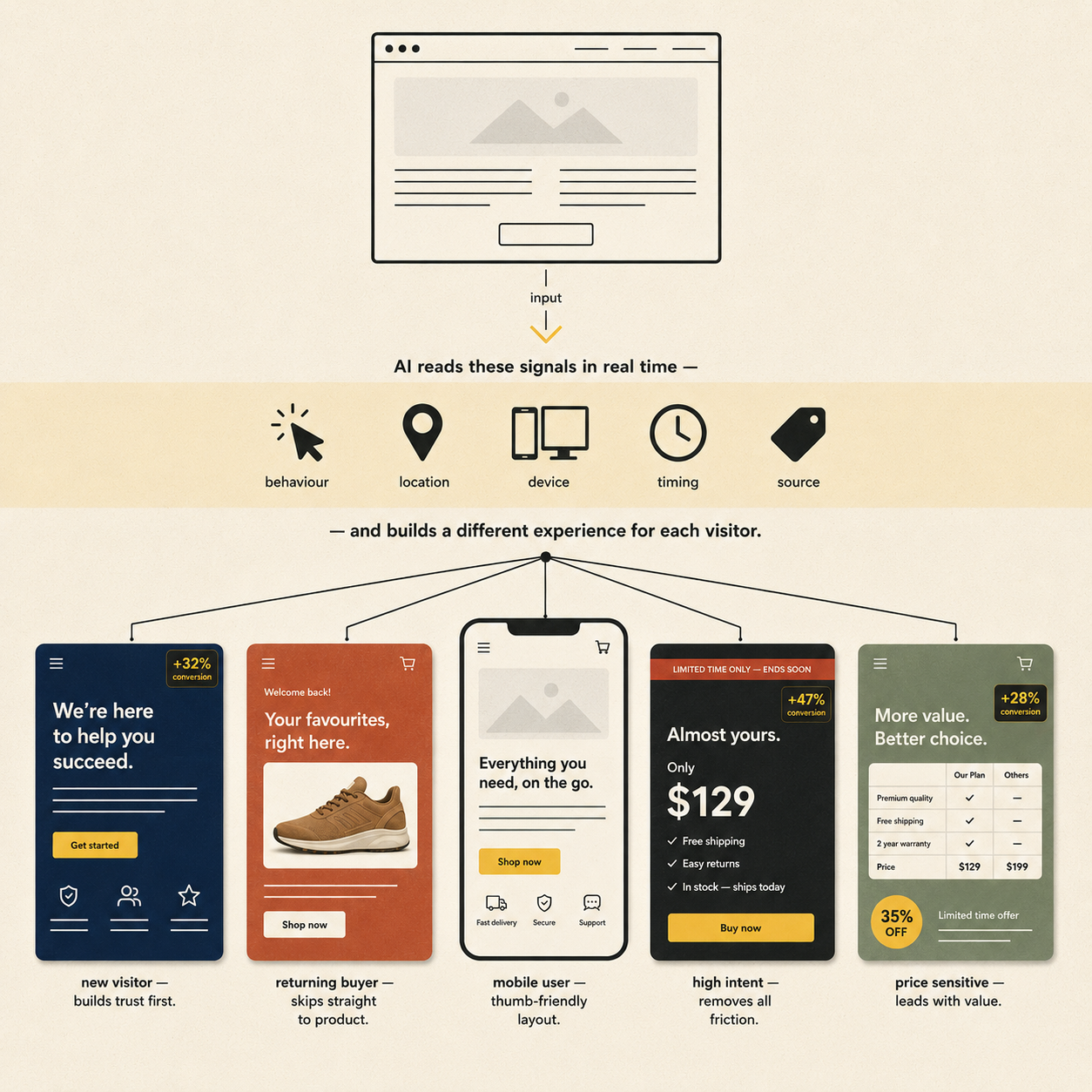
The principle behind all of these tools is the same: every visitor leaves signals. What they searched for. What they clicked. How long they spent on a page. What they added to cart and didn’t buy. AI reads those signals in real time and adjusts the experience accordingly. A visitor who spent three minutes on your sustainability page sees different product imagery and messaging than one who searched for “lowest price.” The same store, the same products, the same backend but an entirely different front-end experience based on who is actually looking.
Here’s a conversion insight that doesn’t make it into enough conversations: visitors who use your website’s search function convert at 2-4 times the rate of visitors who don’t. They’re already telling you exactly what they want. The only question is whether your search can understand them well enough to give it to them.
Traditional keyword search fails when someone types “something comfy for winter evenings” instead of “men’s fleece loungewear medium grey.” AI-powered search understands intent, not just keywords. It handles typos, synonyms, conversational queries, and ambiguous language and returns results that match what the visitor actually meant, not just what they literally typed.
Bloomreach’s AI search capability is one of the most mature in the market for ecommerce. It learns from every search and purchase interaction, continuously improving its understanding of what visitors in specific contexts are actually looking for. For businesses with large product catalogues, this alone can move conversion rates meaningfully without any change to the design, copy, or marketing.
This is the 2026 development that most businesses haven’t implemented yet which means it’s also the largest available competitive advantage for those who do.
Agentic checkout uses AI to make the buying process faster, smarter, and more intuitive. Rather than static checkout flows where every customer follows the same steps, agentic systems adapt in real time based on user behaviour, preferences, and intent. A returning customer with a known address and payment method skips three steps automatically. A first-time visitor from a high-intent traffic source sees a simplified checkout with social proof and a progress indicator. Someone who abandoned checkout last week sees a personalised re-engagement message with the exact item they left behind.
The result: fewer abandoned carts, faster purchase completion, and a checkout experience that feels designed for the specific person going through it rather than for the average of everyone.
By reducing friction and anticipating shopper needs, agentic checkout helps increase conversion rates and addresses the cart abandonment problem that costs ecommerce businesses billions annually. The technology is currently being implemented at scale by enterprise brands — but the underlying capability is becoming accessible through platforms like Shopify, BigCommerce, and WooCommerce through their AI integrations.
62% of customers prefer interacting with chatbots over waiting for human agents for routine queries. That preference has created a conversion lever that most businesses are leaving unused.
AI chat in 2026 is not the scripted, frustrating experience of 2020. Modern conversational AI particularly tools built on large language models can answer complex product questions, compare items across specifications, handle objections, and guide visitors toward the right purchase without a human in the loop. AI chat increases conversion rates by 4x compared to non-assisted sessions, with visitors completing purchases 47% faster when AI assistance is available.
The conversion mechanism is simple: the primary reason people don’t buy is uncertainty. Uncertainty about whether the product is right for them. Uncertainty about sizing, compatibility, shipping, returns. Every unanswered question is a reason to leave without buying. AI chat answers those questions at the exact moment the uncertainty appears — which is the moment that matters most.
Traditional A/B testing is slow. You run a test, wait for statistical significance, implement the winner, run another test. A meaningful optimization cycle takes months.
AI CRO in 2026 generates variations, analyses results, and suggests improvements in one continuous loop. Instead of testing two versions of a headline, it can test forty variations simultaneously including combinations of headline, image, CTA text, and social proof placement and identify the winning combination in a fraction of the time.
Optimizely, named a Gartner Magic Quadrant leader for the second consecutive year in 2026, combines experimentation, content management, and commerce into a unified platform that makes this kind of continuous optimization accessible without a dedicated engineering team. For B2B businesses specifically, Mutiny approaches this from an account-based marketing angle dynamically adjusting website content based on the visiting company’s industry, size, and intent signals. Mutiny’s client list includes Dropbox, Snowflake, and Qualtrics, and the platform has raised $72 million from Sequoia Capital which tells you how seriously the market is taking AI-driven conversion optimization.
How businesses use AI to improve website conversion. Let’s get specific. Here is how a mid-sized ecommerce business, let’s say an Indian D2C brand selling premium skincare, doing ₹2-5 crore annually should be thinking about AI and conversion in 2026. The same framework applies to any product-based ecommerce business.
Before any AI personalisation can work, you need visitor intelligence. Most ecommerce businesses know their average customer. They don’t know the five or six distinct visitor types who land on their site with completely different contexts and intentions.
Install Microsoft Clarity immediately it’s free and its AI session analysis tells you where different types of visitors are dropping off, what they’re clicking that isn’t a link, and where confusion appears in the user journey. This is the foundation everything else builds on.
Then segment your visitors properly: new visitors from paid ads behave differently from returning customers. Visitors from Instagram behave differently from those from Google organic. Mobile visitors convert differently from desktop. Once you know who is on your site and how they behave differently, you can start personalising for each group.
The homepage and landing pages should not be static in 2026. A visitor arriving from a Google ad for “vitamin C serum for oily skin” should land on a page that speaks specifically to that intent not your generic homepage that tries to speak to everyone.
This is achievable without enterprise-grade tools. Nosto and Bloomreach offer mid-market accessible pricing. For bootstrapped or early-stage businesses, even basic traffic source-based personalization showing different hero content based on the UTM parameters of incoming traffic can move conversion rates meaningfully.
The principle: the closer your landing experience matches the intent that brought someone to your site, the more likely they are to convert. AI makes it possible to maintain dozens of different entry experiences simultaneously without maintaining dozens of different pages.
Most ecommerce sites have a product discovery problem they don’t know about. Visitors land, scroll, feel mildly overwhelmed by options, and leave without finding what they were looking for even when you stock exactly what they needed.
AI-powered recommendations solve this. Not the “customers also bought” recommendations that were popular five years ago those were based on purchase co-occurrence data and were often irrelevant. Modern AI recommendations use real-time behavioral signals what the visitor is looking at right now, how long they spent on each product, what search terms brought them to the site to surface products that match their specific intent in this specific session.
Companies using AI personalization earn 40% more revenue from their existing traffic – not from acquiring more visitors, but from converting more of the visitors they already have. For a business doing ₹3 crore annually, a 40% lift from existing traffic is ₹1.2 crore in additional revenue without spending an extra rupee on acquisition.
Cart abandonment is the most visible conversion failure but it’s not the only one. Visitors who viewed a product three times without adding to cart, visitors who started a quiz or configurator and didn’t complete it, visitors who spent significant time on a category page without purchasing all of these represent intent that didn’t convert.
AI identifies these signals in real time and triggers recovery sequences automatically. An email within twenty minutes of cart abandonment featuring the exact abandoned product. A browser push notification for a returning visitor showing a restock of something they viewed. A personalized homepage experience for a returning visitor that leads with the category they spent the most time in last session.
Omnichannel cart abandonment campaigns are among the highest-impact conversion strategies in 2026 ecommerce because they reach people who have already shown buying intent, at the moment that intent is most likely to still be active.
The final stage of an AI conversion strategy is the one that compounds over time: continuous optimization that runs without requiring constant human intervention.
This means AI that tests copy variations on product pages automatically. AI that adjusts the order in which products appear in category listings based on what’s converting best for each visitor segment. AI that identifies which trust signals reviews, guarantees, social proof are moving the needle for which visitor types, and surfaces them more prominently in those contexts.
In 2026, AI CRO is no longer an experiment – it is standard practice for ecommerce brands that take conversion seriously. The businesses building compounding advantages right now are the ones running continuous optimisation loops, not point-in-time redesigns.

Here is the thing that almost nobody in the AI conversion conversation is saying clearly enough.
The goal of AI in website conversion is not to trick more people into buying. It is to remove the gap between what a visitor is looking for and what your website shows them. Every personalization, every AI recommendation, every smart checkout adaptation these work because they make the experience more genuinely useful to the specific human going through it.
The businesses that implement AI conversion tools and see the biggest results are not the ones that use AI to be manipulative. They are the ones that use AI to be relevant. There is a meaningful difference and it shows up in retention rates, return customer rates, and brand reputation over time, not just in short-term conversion lifts.
A website that converts better because it’s genuinely more helpful to each visitor is building something that compounds. A website that converts better because it’s optimized for dark patterns is building something fragile.
The AI exists. The tools exist. The data exists. The question is what you do with them and whether the answer makes your business more genuinely useful to the people it serves.
That is the conversion strategy worth building in 2026.
The trajectory of AI in website conversion points toward one outcome: websites that function as intelligent, adaptive systems rather than static pages.
As agentic AI becomes more embedded in ecommerce platforms, businesses can use it to run storefronts that optimize themselves continuously. The personalization that requires careful setup and ongoing management in 2026 will be increasingly autonomous in 2027 – AI that designs its own tests, interprets its own results, and implements its own improvements within defined parameters.
The businesses that will be positioned to use those capabilities in 2027 are the ones building the data foundations, the visitor intelligence, and the personalization infrastructure right now. You cannot implement advanced AI optimization on a website that has no behavioral data, no segmentation, and no existing testing culture.
The runway is shorter than it feels. Start with Clarity. Add one personalization layer. Run one A/B test. Build the muscle because in 2027, the gap between businesses that have and haven’t done this is going to be significantly wider than it already is.
External sources referenced in this article: