Posted by Debjit
in Accessories
in Accessories
How ChatGPT and Claude Help Write Better Website Copy – And Which One to Use for What

How ChatGPT and Claude help write better website copy is one of those questions that sounds simple on the surface but gets genuinely interesting the moment you go past the obvious answer.
The obvious answer is: yes, both can write website copy, both are good, use whichever you prefer. That answer is technically correct and completely useless. Because the real question – the one that saves you hours every week is not whether they can write copy. It’s knowing when to use which one, for which section, with which kind of prompt, to get copy that actually works on a real website for a real business.
That’s what this article is about. No vague comparisons. No paid-tool sponsor language. Just a practical, specific breakdown of how to use both tools together to write website copy that converts based on real testing, real data, and patterns that are showing up consistently in 2026.
Before getting into ChatGPT versus Claude, let’s talk about the real problem.
You’ve seen it. You’ve probably produced it once or twice without realising. It’s the kind of copy that is technically correct, grammatically fine, covers the right topics and somehow says nothing. The hero headline that could describe any business. The about page that sounds like a LinkedIn bio written by a committee. The CTA that says “Get Started Today” because that’s what AI defaults to when you don’t tell it anything specific.
The problem isn’t the AI. The problem is that most people prompt AI the same way they would Google. “Write me a hero section for my web design business.” That’s not a prompt. That’s a search query. And what you get back is essentially an average of every hero section ever written which is exactly what average feels like.
Brands with clear, specific messaging see up to 23% higher conversion rates than those with vague or generic copy. That 23% gap lives almost entirely in the quality of the input you give the AI not in which AI tool you chose.
This matters before anything else because everything that follows assumes you’re going to give these tools something real to work with. If you don’t, neither ChatGPT nor Claude can save you from generic.
There are real differences between these two tools for copywriting purposes not marketing differences, not benchmark differences, actual practical differences that show up in the quality of the output when you’re writing real website sections.
Claude Sonnet 4.6 writes with more natural cadence, better paragraph structure, and stronger adherence to tone instructions than competing models. For marketing copy, long-form content, or anything where brand voice matters – Claude is consistently the stronger performer. It follows detailed instructions faithfully across a long conversation. Give it a nuanced brief about a brand’s personality, audience, and positioning and it holds that thread throughout.
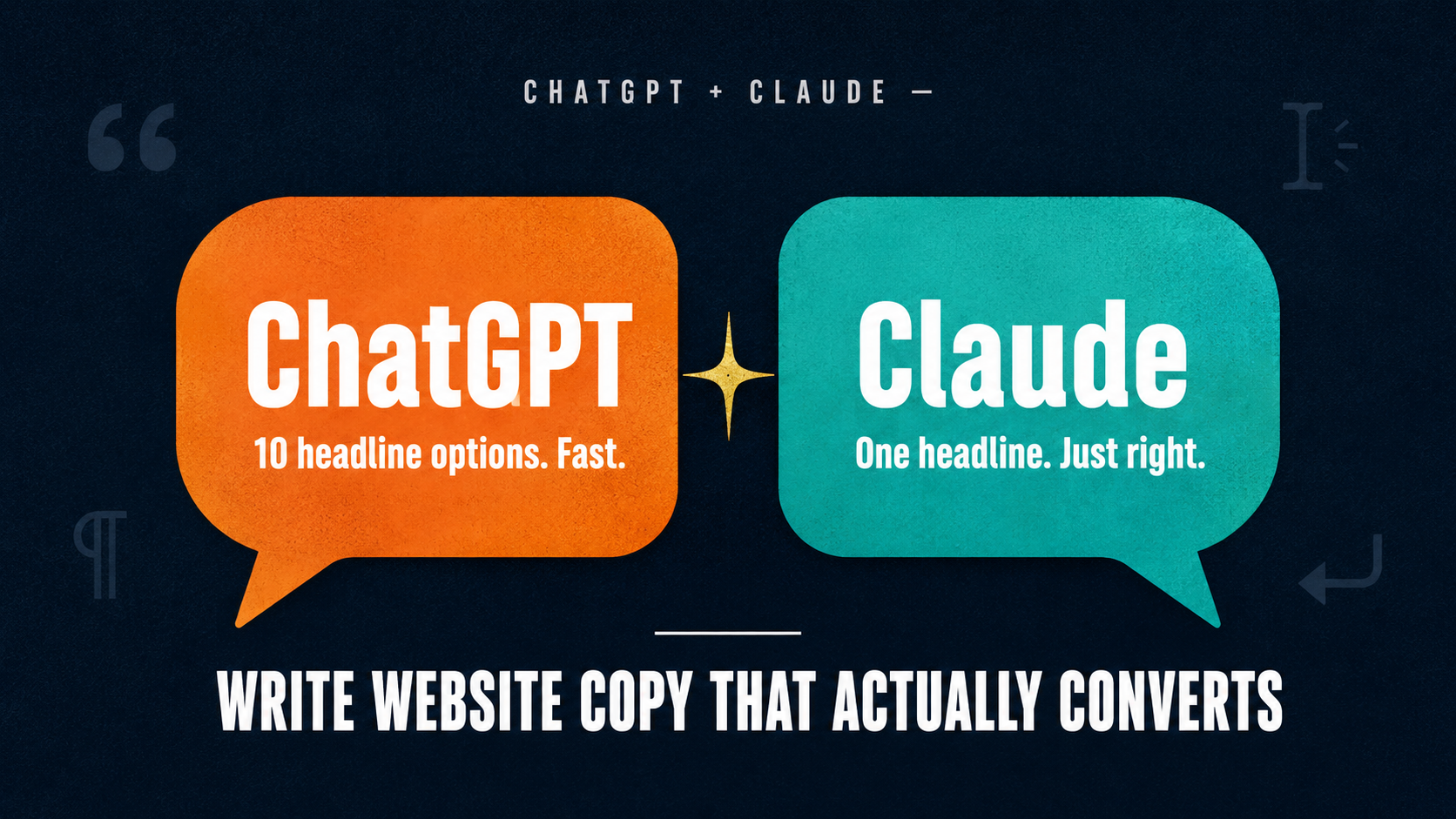
ChatGPT produces competent website copy at speed particularly useful for generating multiple headline variants, producing first drafts quickly, and iterating through copy options fast. It is broader, more versatile, better at creative angle generation when you need volume. It also has one practical advantage that matters for web design workflows: it can browse the web, pull references, and incorporate current information directly into copy in a way Claude does with its own search capability now too but ChatGPT’s browsing integration feels more seamlessly baked into how it reasons.
Here is the practical split that comes up again and again in real testing:
Use Claude for: Hero sections that need precise brand voice, about page storytelling, long service page copy, any copy that needs to feel warm and human rather than competent and professional. Claude pushes back when your brief is vague which is annoying until you realise it’s pushing you toward better output.
Use ChatGPT for: Generating ten headline options fast, producing a first draft to react to, writing copy variations for A/B testing, getting unstuck when you’re staring at a blank page. ChatGPT is more compliant it will give you what you ask for quickly, which is what you need at the ideation stage.
A study testing both across 500+ ad variations found Claude wins on natural tone and instruction-following, while ChatGPT excels at creative angles and generating copy volume. That pattern holds for website copy too.
The move that most working designers have landed on in 2026: use ChatGPT to explore, use Claude to refine. Start broad, go specific. That workflow alone will improve your output noticeably.
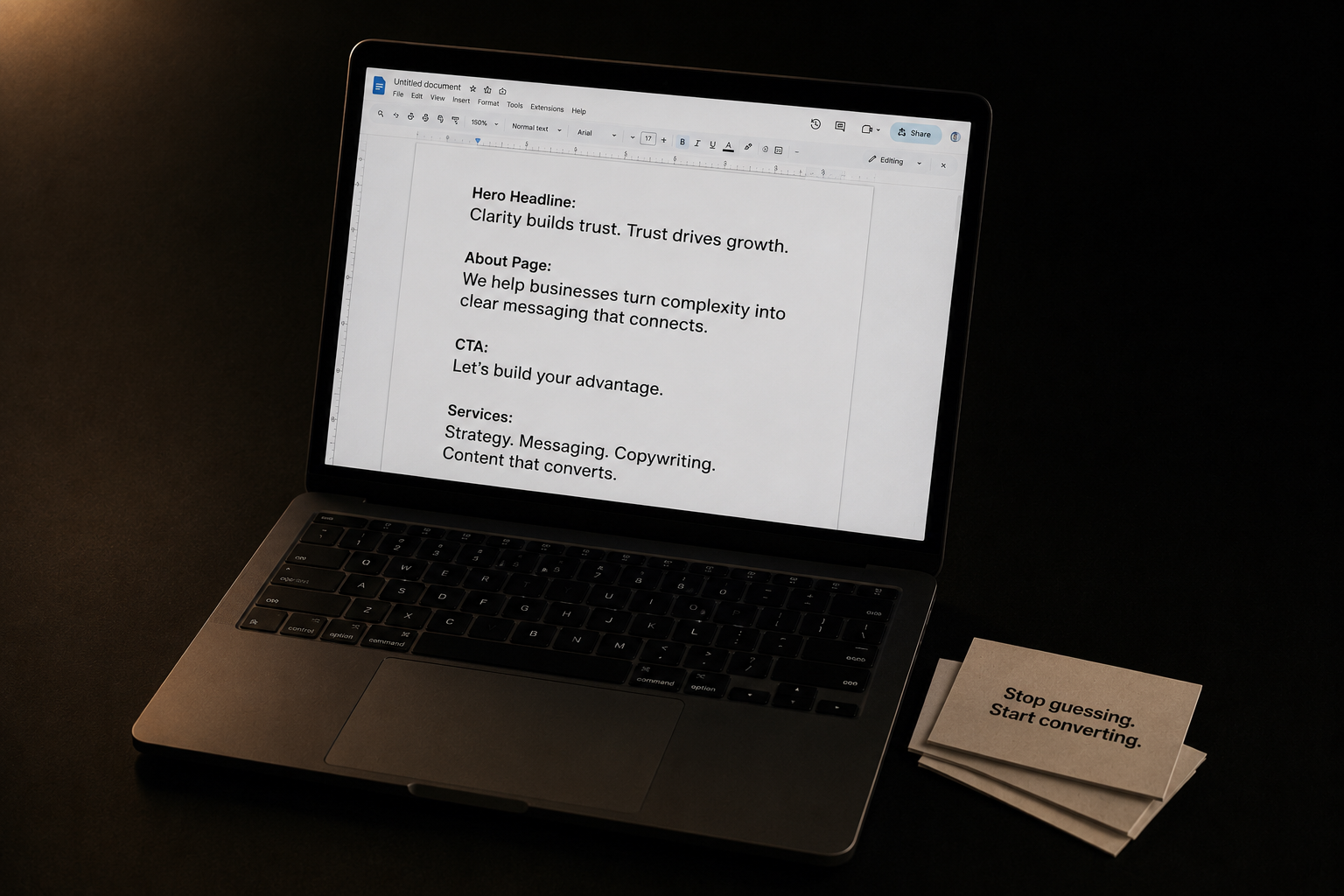
The hero section is the most important copy on any website. It’s also the section where AI-generated copy fails most visibly because generic hero headlines are everywhere and readers have learned to filter them out instantly.
Use Claude for hero sections. Here’s why: a good hero headline requires understanding the specific emotional state of the reader at the moment they arrive their anxiety, their hope, what they’ve already tried, what they’re afraid of. Claude’s ability to hold complex character descriptions and follow nuanced tone instructions makes it significantly better at producing hero copy that feels written for a specific person rather than a demographic.
The prompt that works: don’t ask for a hero section. Describe the customer. Their problem, in their language. What they’ve already tried that didn’t work. What they’re really looking for. Then ask Claude to write a headline that speaks to that person not to the business.
Example prompt structure:
“My client is a small Indian restaurant owner in Bangalore. Their customers are young professionals who are tired of ordering the same delivery food. They want a restaurant that feels special without being expensive. The restaurant’s unique thing is that every dish has a specific story sourced ingredients, regional recipes. Write three hero headlines that speak to someone who wants food with meaning, not just food.”
That is a prompt. “Write a hero section for a restaurant” is a search query.
Personalised CTAs convert 202% better than generic ones – that is not a rounding error. That 202% figure from HubSpot’s analysis of 330,000 CTAs is a direct argument for putting real effort into your hero section prompts rather than accepting the first thing an AI generates.
About pages are where most businesses sound exactly like every other business. “We are a passionate team dedicated to delivering exceptional results for our clients.” You’ve read that sentence on a hundred websites. So has everyone else.
This is Claude’s strongest territory. About pages require something AI struggles with by default: genuine specificity. The founder’s actual story. The decision that changed the business direction. The moment the brand became what it is. Claude, given enough real information to work with, produces about page copy that reads like it was written by a thoughtful person not assembled from brand voice templates.
The difference between a Claude about page and a ChatGPT about page given the same brief comes down to one thing: Claude is more likely to push back and ask for more information. ChatGPT is more likely to fill the gaps with plausible-sounding generic content. For an about page, you want the pushback. Generic about pages are invisible. Specific ones build trust.
The prompt approach: give Claude the founder’s actual story in bullet points – messy, incomplete, human. Ask it to find the narrative thread and write the about page around that. Don’t clean up the input before you paste it. The messiness is where the real story lives.
Service pages have a structural problem that AI actually solves well if you prompt it correctly. Most service pages describe what the service is rather than what it does for the client. The difference between “we offer custom web design” and “we build websites that turn visitors into paying clients” is the difference between a service page that gets ignored and one that generates enquiries.
Both tools work well here with different approaches.
Use ChatGPT to generate the structure and the benefit-led language fast. Ask it to rewrite every feature as a client outcome. “Custom design” becomes “a website that looks like nothing else in your industry.” “Responsive layout” becomes “a website that works perfectly for your clients on any device, without you thinking about it.” ChatGPT is good at this transformation when you give it the feature list and ask specifically for the outcome-led version.
Then use Claude to refine the tone especially if the client has a specific brand voice. Paste the ChatGPT draft and ask Claude to make it sound more like a conversation and less like a sales page.
Simply shifting CTA copy from second-person to first-person – “Start Your Free Trial” to “Start My Free Trial” — increases clicks by up to 90%. Ask either tool to rewrite every CTA in first person. It takes sixty seconds and makes a measurable difference.
Below the hero, most homepages get worse. The hero worked hard to earn attention and then a wall of generic paragraphs loses it.
The structure that consistently works for business websites in 2026: social proof immediately after the hero, then problem identification, then solution, then how it works, then another CTA. Most businesses do it in the wrong order they lead with what they do, not with the client’s problem.
Use this prompt structure with either tool:
“I need homepage body copy for [business type]. The reader has just seen the hero and is still not sure if this is for them. Write the next three sections: 1) A social proof section using these specific results [paste real results]. 2) A problem section that names the specific frustration this client type feels before finding us. 3) A solution section that explains how we solve it without using jargon. Keep each section under 80 words.”
The word count constraint is important. AI will fill as much space as you let it. Constraining it forces it to prioritize which is what good copywriting does anyway.
Most people think CTAs are one button. They’re not. Every page has multiple decision points and every decision point needs copy that matches the reader’s position in the journey.
A visitor reading your hero section is at maximum uncertainty. “Get Started” is too much of an ask. “See How It Works” or “Show Me an Example” respects where they are.
A visitor who has read your entire services page and scrolled to the bottom has made a much larger mental commitment. “Let’s Talk” or “Book a Call This Week” is appropriate there.
Use ChatGPT for CTA generation. Ask it to write fifteen CTA variations for each section of a page – specifying the reader’s emotional state at that point in their journey. Pick the three that feel right. Test them. The volume generation is where ChatGPT’s speed advantage matters most.
AI can apply proven copywriting frameworks – AIDA, PAS, BAB – and generate complete page copy that follows conversion best practices. For CTAs specifically, the PAS framework (Problem, Agitate, Solution) produces CTA copy that feels more emotionally resonant than generic action phrases. Ask ChatGPT to write five CTAs using PAS for a specific page section and compare the output to your usual approach.
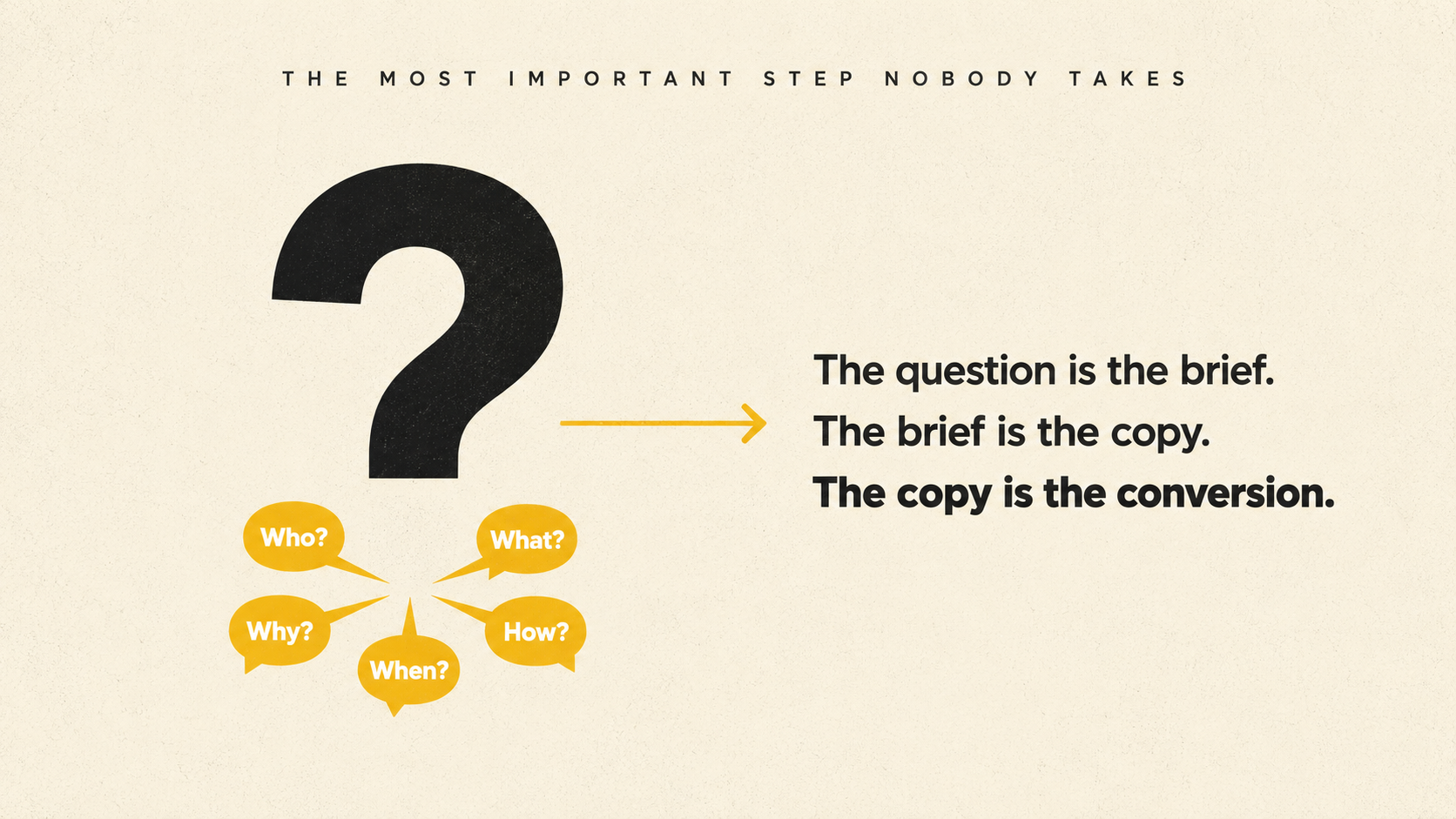
Here is the most useful thing in this entire article and it’s almost never mentioned in AI copywriting guides.
Before writing any website copy with AI, run this prompt first in whichever tool you’re using:
“I am going to give you a brief for website copy. Before I do, I want you to ask me every question you would need answered to write copy that feels genuinely specific to this business and this audience not generic. Don’t write anything yet. Just ask the questions.”
Then answer those questions. Then ask for the copy.
The questions the AI asks you are the brief you should have written yourself. They are also the exact information that separates copy that converts from copy that exists. Claude in particular asks notably sharp questions questions about the client’s specific hesitations, about what makes the business different in practice rather than in principle, about what the best clients have said they valued most.
This technique adds ten minutes to the start of your copywriting process. It removes an hour of revision from the end of it. And the output quality difference is significant enough that once you start doing it, you’ll never go back to cold prompting.
Neither ChatGPT nor Claude can replace two things that make website copy work in the real world.
Client interviews. The best website copy comes from things the client’s customers have actually said specific phrases, specific frustrations, specific language that resonates because it came from a real human describing a real experience. AI can approximate this from a brief. It cannot replicate it. The twenty minutes you spend asking a client “what do your customers say when they first describe their problem to you?” is worth more to the copy than any prompt technique.
Post-launch iteration. Copy that converts is copy that has been tested against real visitors making real decisions. AI writes a first draft, not a final draft. The difference between a website that converts at 1% and one that converts at 3% is almost always in the copy and that difference is discovered through analytics, heatmaps, and user feedback, not through better prompting.
The practical workflow in 2026 that is producing the best results: use AI to write fast and write multiple options, use real client language to make it specific, use post-launch data to know what to improve.
For a freelance web designer or agency writing copy for client websites, the time maths are worth looking at directly.
A full five-page website – home, about, services, portfolio, contact used to take two to three days of copywriting time when done properly. Using ChatGPT for first drafts and Claude for refinement, that same scope takes four to six hours of focused work. Not because corners are being cut. Because the mechanical part getting words on the page is no longer the bottleneck. The judgment part deciding what to keep, what to change, what needs a different angle — still takes a human.
That time saving compounds. Over a month of client projects, that is multiple days of recovered capacity. Days you can spend on another project, on business development, on the kind of work that requires your specific expertise rather than your typing speed.
The designers and agencies who have built AI copywriting into their standard workflow aren’t producing worse work. They are delivering faster, charging the same or more, and using the recovered time to take on projects they would previously have had to turn down.
That is the real argument for learning to use both tools well. Not that AI writes better than humans. It doesn’t, on its own. But a designer who uses AI well writes better than a designer who doesn’t and does it in a fraction of the time.
The gap between good and generic AI copy is going to get harder to see at the surface level models are improving rapidly and the baseline quality of even lazy prompting is rising. But the gap in what the copy achieves the conversion difference, the trust difference, the brand distinctiveness difference is going to widen, not narrow.
Because the businesses producing better copy in 2027 won’t be the ones with access to better AI tools. Everyone has access to the same tools. They’ll be the businesses that invest in better inputs real customer language, specific positioning, genuine brand voice and feed those inputs into the AI with more skill and more strategy.
The tool is commoditising. The thinking behind the prompt is not.
That is where your value as a designer, copywriter, or agency owner sits in 2027. Not in knowing which AI to use. In knowing what to tell it.