AI Can Build Beautiful Websites – So Why Aren’t They Converting?



If your website is not converting visitors into leads, you’re not alone…. You used AI tools to generate a stunning layout, polished the copy, made sure it looked great on mobile – and then you launched.
Traffic trickled in. People visited. And then… nothing.
No leads. No sales. No sign-ups. Just a beautifully designed ghost town.
If this sounds familiar, you’re not alone. Here’s the truth no one talks about: design was never the finish line. It was always just the entrance.
The real problem isn’t how your website looks. It’s what it makes your visitors feel, understand, and do – in that order.
There’s no question that AI has transformed how websites are built. Tools like Framer AI, Webflow, and Wix ADI have compressed what used to take weeks into hours. Add ChatGPT or Claude for copywriting, and you can have a complete, responsive, polished site up before lunch.
AI can now generate professional layouts instantly, suggest color palettes, write decent first-draft copy, and optimize for mobile automatically. The barrier to entry has collapsed – anyone can have a site that looks like it belongs to a venture-backed startup.
But beauty is not a business strategy. And this is where the gap begins.
The moment a visitor lands on your website, they aren’t thinking “wow, this looks incredible.” They’re asking: “Is this for me? Can this solve my problem?”
Users scan pages – they don’t read them. They make decisions within seconds. If your headline doesn’t immediately communicate what you do and who you help, they’re gone – regardless of how beautiful the gradient is.
Confusion kills conversions faster than bad design ever could.

This is the most underappreciated problem in AI-generated web design – and the one that costs businesses the most revenue.
AI understands patterns. It replicates the structure and aesthetics of high-performing websites with ease. But it doesn’t inherently understand the human emotional journey that happens before someone decides to buy – the buying anxiety, the trust hesitation, the need to feel like a brand actually gets you.
A truly high-converting website is engineered around these emotional checkpoints. It anticipates doubt and neutralizes it. It signals credibility before the visitor has to ask. Left to generate on autopilot, AI produces websites that look right but feel generic. And people buy from emotion, even when they think they’re buying from logic.
AI design tools are trained on the same pool of templates and design systems. The result? Millions of businesses now share the same hero section, the same three-icon feature block, the same blue CTA button.
When everything looks the same, nothing stands out. And when nothing stands out, no emotional memory is created. A visitor who can’t distinguish you from three competitors has no reason to choose you.
Brand distinctiveness – the quality of being genuinely recognizable – is one of the most powerful conversion drivers. It’s also one of the first casualties of over-relying on AI templates.
Most business owners evaluate their website like a piece of art: does it look good? Does it feel premium?
These are valid questions – but they’re the wrong ones to ask first. The questions that determine whether a website actually converts are:
Conversion psychology is a discipline. A website built around these principles will outperform a beautiful website with no strategic thinking – every single time.
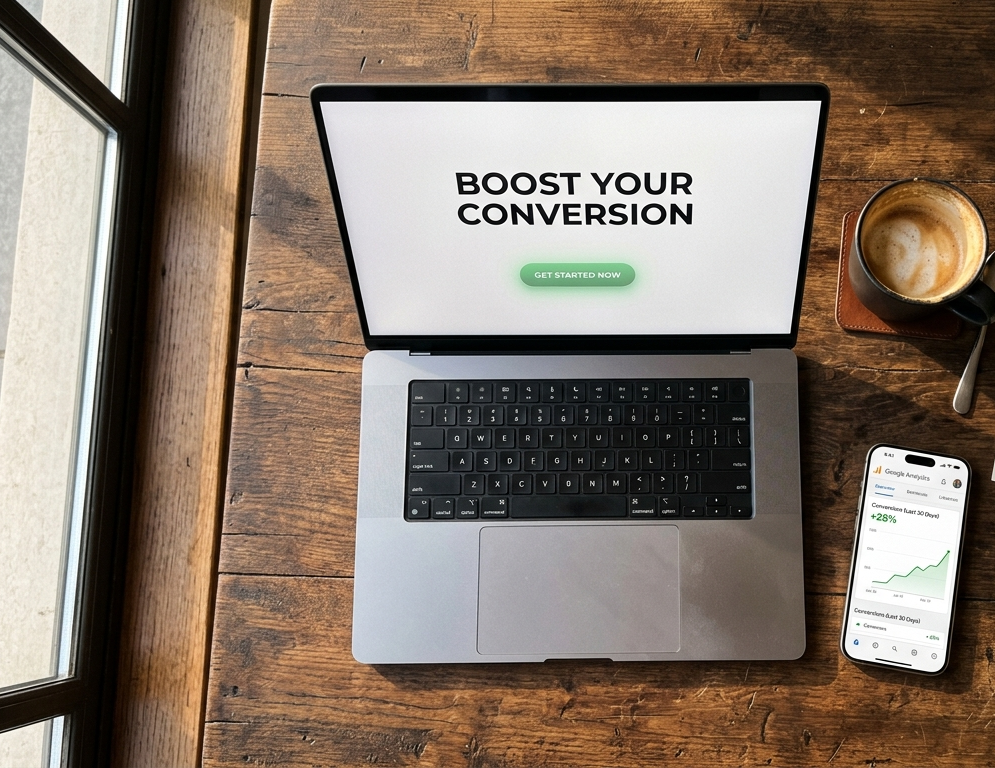
Trust is built through evidence, not declaration. A site that says “we’re the best” converts worse than one that shows it – through verified testimonials, case studies, and credentials placed exactly where doubt surfaces.
Simplicity reduces cognitive load. Every element that doesn’t serve the conversion is quietly working against it. The websites that convert best feel the easiest to navigate not because they’re simple businesses, but because their UX removes friction at every step.
Social proof is the most powerful form of persuasion. We’re wired to look to others when making decisions under uncertainty. Testimonials, star ratings, and client logos placed at the right moment in the user journey can dramatically move conversion rates.
Speed is a trust signal. A slow website doesn’t just frustrate visitors – it signals, subconsciously, that the business behind it is careless or under-resourced. Page load speed affects both SEO rankings and your site’s emotional first impression.
AI isn’t the villain here. The problem is unsupervised AI. When guided by strategy and human psychology, AI is one of the most powerful conversion tools available.
AI-assisted copywriting – Claude and ChatGPT can rapidly test headlines, CTAs, and value propositions. The key: give them detailed context about your customer’s specific pain points and language. Vague prompts produce generic copy. Strategic prompts produce conversion-ready messaging.
Behavior analysis – Tools like Microsoft Clarity use AI to surface where users drop off, what they click that isn’t a link, and where they hesitate — insights that would take human analysts weeks to find.
A/B testing – AI can run and analyze multivariate tests simultaneously, identifying winning combinations of headlines, layouts, and CTAs far faster than traditional methods.
Personalization – AI enables dynamic content that adapts based on traffic source, location, or intent. A visitor from a Google ad for wedding photographers should see a different experience than someone who searched family portrait sessions.
The businesses winning in 2026 aren’t choosing between human strategy and AI capability. They’re combining both.
The barrier to a good-looking website is now essentially zero. Any business can have a professional, responsive, polished presence online within hours.
Which means design is no longer the differentiator.
The differentiator is depth – depth of understanding your audience, depth of your brand’s emotional resonance, depth of your conversion strategy. These are things AI can assist with but cannot generate on its own.
The websites that will dominate going forward will be built at the intersection of AI efficiency, human psychology, brand distinctiveness, and authentic storytelling. Not just the ones that look the best – but the ones that think the best.
AI is the most powerful tool in that system. But the thinking? That still has to be yours.